The Jobs We Haven’t Invented Yet
The Jobs We Haven’t Invented Yet
Designing Human Work for an AI and Robotic Future
We may be missing the point of the AI employment conversation. Most discussions about the future of work begin with the same questions:
Which jobs will AI eliminate?
Which workers will be displaced?
Which professions are safe?
Which skills should people learn to remain employable?
These are necessary questions, but they are defensive questions. They assume the future of employment will be determined primarily by what machines can take from humans. That is not the only future available to us.
This is also a time for invention. Instead of asking only which current jobs will survive, we should be asking: What new forms of human work become possible when intelligence, simulation, production, and physical execution are no longer as scarce as they once were?
This question poses a different conversation. It moves us beyond retraining people for slightly modified versions of existing jobs. It asks us to reimagine employment itself.
Science fiction has spent generations showing us intelligent machines, autonomous cities, robotic construction, synthetic environments, space settlements, digital civilizations, and technologies that reshape physical reality.
But science fiction usually focuses on the invention.
It shows us the robot, spaceship, artificial intelligence, virtual world, or automated city. It spends far less time showing us the ordinary human occupations that must emerge around those inventions.
Who directs a mixed workforce of humans, robots, and AI agents?
Who teaches a robot what an experienced worker notices before an accident?
Who determines which decisions must remain under human authority?
Who represents workers whose movements, voices, judgment, and expertise are used to train machines?
Who designs the social behavior of robots operating around children, elders, patients, customers, and communities?
Who decides what should be built once machines can build almost anything?
Those are not side questions. Those may be some of the most important employment questions of the next five years.
The Future of Work Is Still Being Written
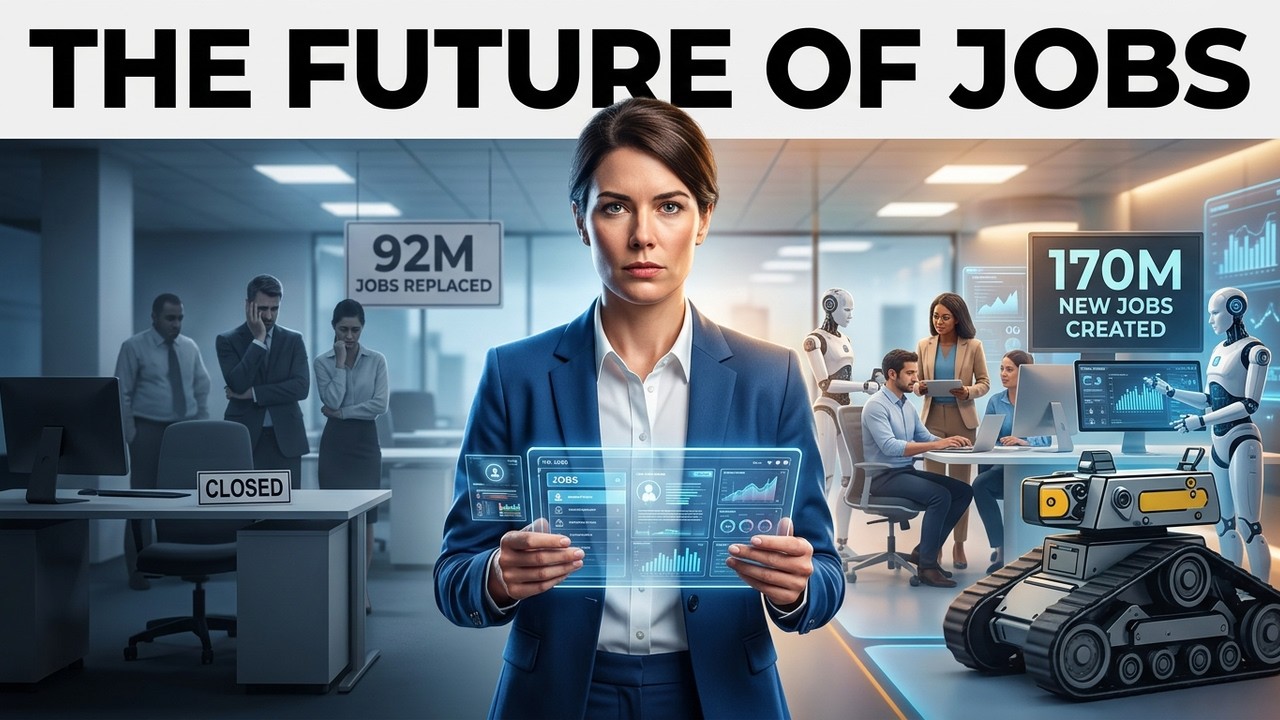
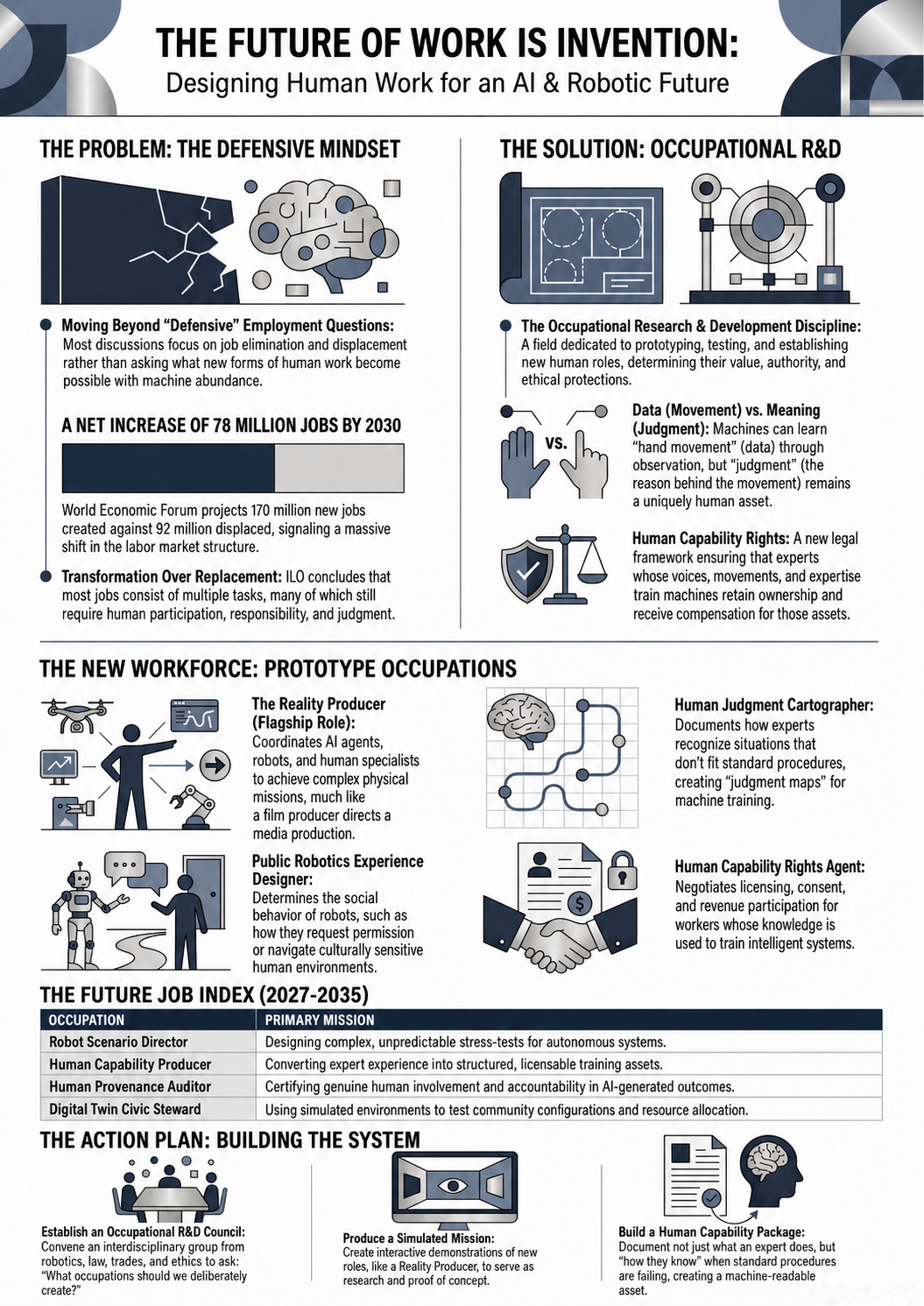
The disruption is real. The World Economic Forum projected that labor-market changes could create approximately 170 million jobs while displacing 92 million by 2030, producing a net increase of roughly 78 million jobs worldwide. It also estimated that about 22 percent of existing jobs would be disrupted during that period.
The International Labour Organization has reached a similarly important conclusion: transformation is more likely than complete replacement for many occupations because most jobs consist of multiple tasks, many of which still require human participation, responsibility, interpretation, or judgment.
That means the future is not simply:
Human or machine.
It is increasingly:
Human with machine.
But even that framing may be too limited.
The real opportunity is not simply attaching AI to today’s job descriptions. It is creating occupations that could not have existed before intelligent systems, advanced robotics, digital twins, synthetic environments, and autonomous production became available.
We do not merely need job preservation. We need occupational invention.
A New Discipline:
Occupational Research and Development
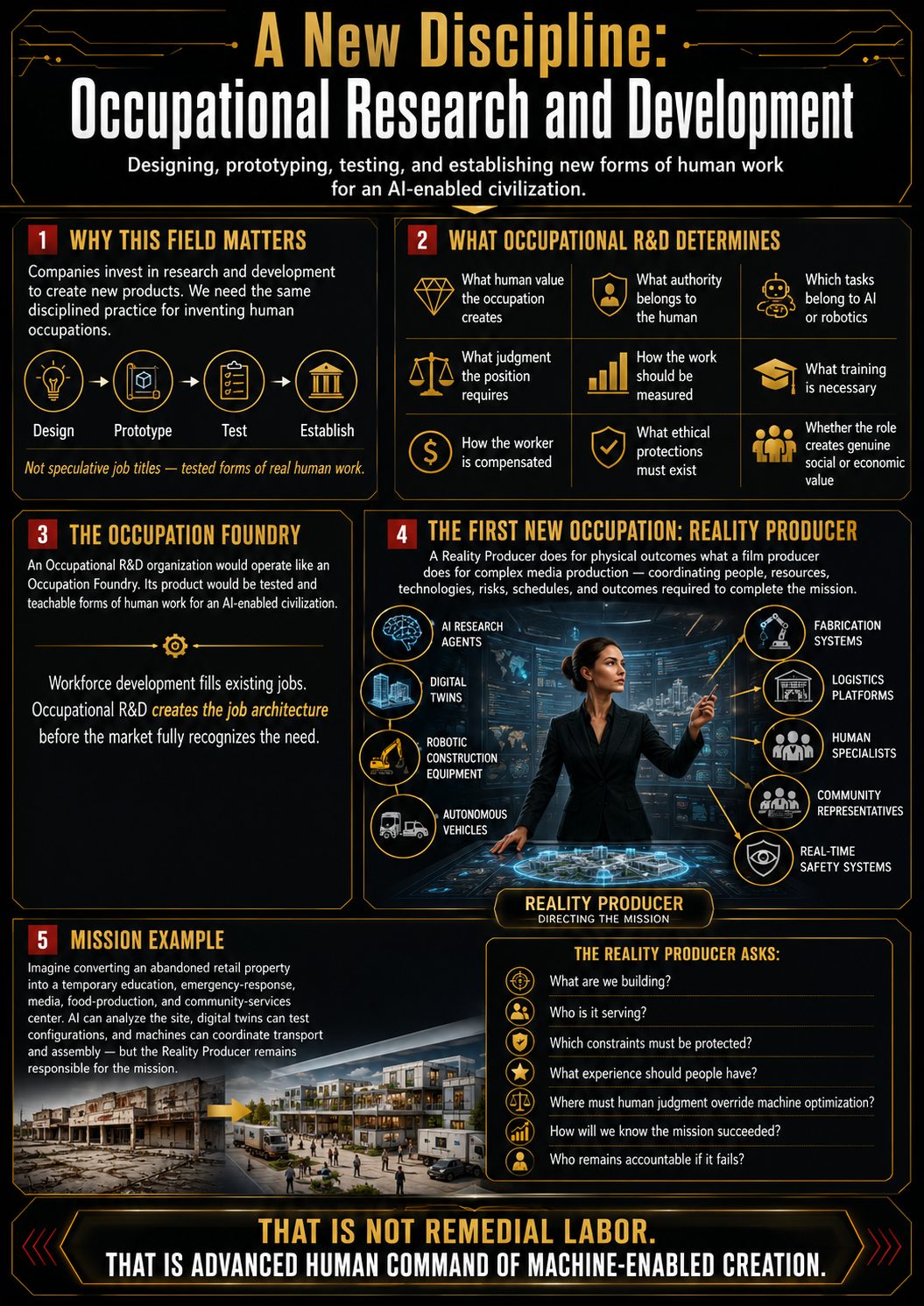
Companies have research and development departments for new products. They develop prototypes, test materials, study markets, build experimental systems, and determine whether an invention can become commercially useful.
Why do we not have the same kind of disciplined practice for inventing human occupations?
We need a field I call:
Occupational Research and Development
Occupational R&D would deliberately design, prototype, test, and establish new forms of human work.
It would not simply publish lists of speculative job titles.
It would determine:
what human value the occupation creates;
what authority belongs to the human;
which tasks belong to AI or robotics;
what judgment the position requires;
how the work should be measured;
what training is necessary;
how the worker is compensated;
what ethical protections must exist;
and whether the role creates genuine social or economic value.
An Occupational R&D organization could operate like an Occupation Foundry.
Its product would not initially be another AI application or robot.
Its product would be:
Tested and teachable forms of human work for an AI-enabled civilization.
That is different from workforce development.
Traditional workforce development responds to jobs companies have already created.
Occupational R&D would create the job architecture before the market fully recognizes that it needs it.
The First New Occupation: The Reality Producer
One of the first occupations I would prototype is the:
Reality Producer
A Reality Producer would do for physical outcomes what a film producer does for a complex media production. A film producer does not personally operate every camera, build every set, negotiate every agreement, edit every scene, manage every schedule, and perform every role.
The producer coordinates the people, resources, technologies, risks, creative intentions, schedules, and outcomes required to complete the mission.
Now extend that ability into an environment containing:
AI research agents;
digital twins;
robotic construction equipment;
autonomous vehicles;
fabrication systems;
logistics platforms;
human specialists;
community representatives;
and real-time safety systems.
The Reality Producer would direct the complete operation.
Imagine an abandoned retail property that must be converted into a temporary education, emergency-response, media, food-production, and community-services center.
An AI planning system could analyze the location.
A digital twin could test possible configurations.
Robots could transport equipment and assemble temporary structures.
Autonomous systems could coordinate deliveries.
Specialists could verify electrical, medical, accessibility, and safety requirements.
The Reality Producer would remain responsible for the overall mission:
What are we building?
Who is it serving?
Which constraints must be protected?
What experience should people have?
Where must human judgment override machine optimization?
How will we know the mission succeeded?
Who remains accountable if it fails?
That is not remedial labor.
That is advanced human command of machine-enabled creation.
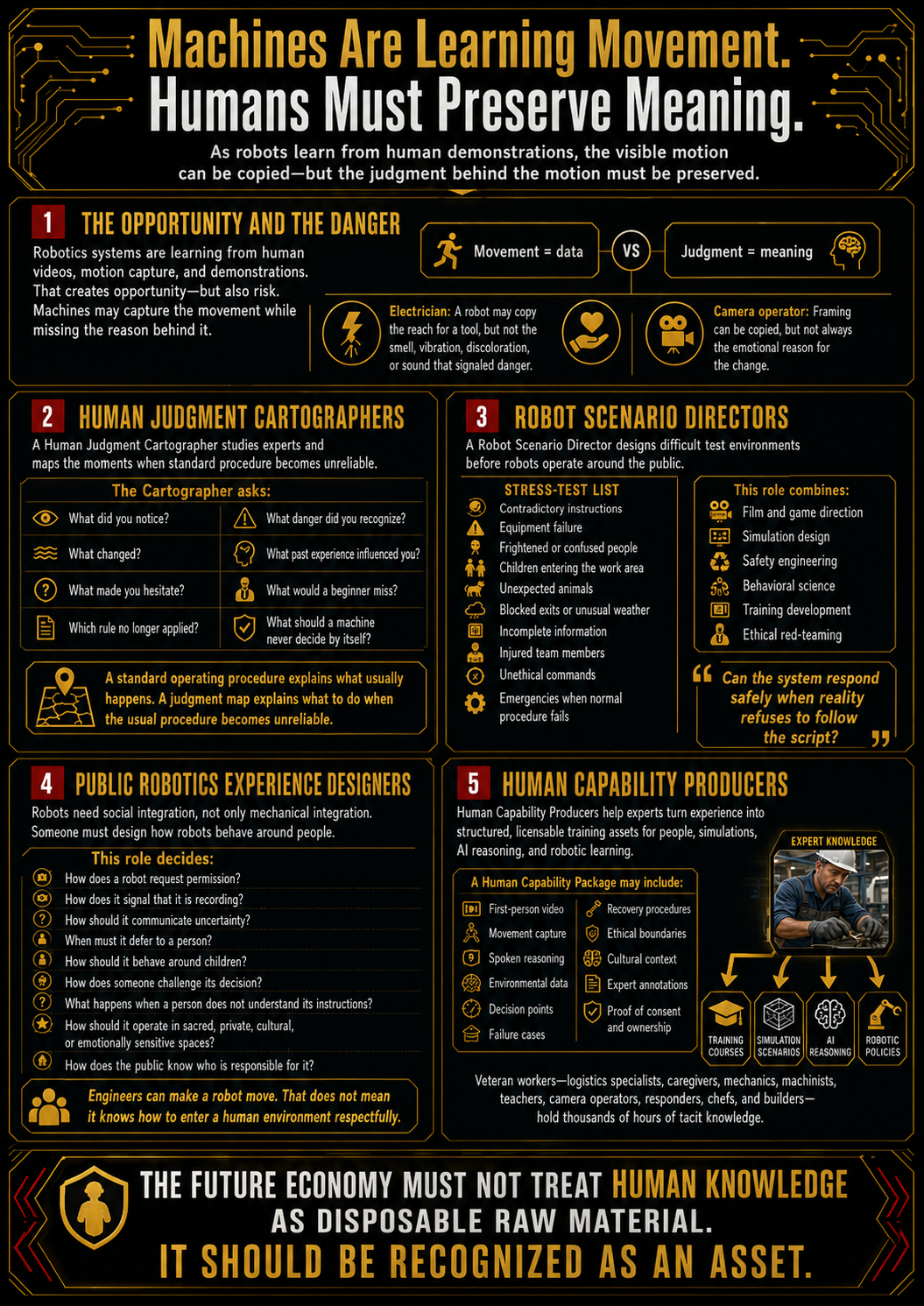
Machines Are Learning Movement.
Humans Must Preserve Meaning.
Robotics research is already using human videos, motion capture, demonstrations, and other behavioral data to teach machines new skills. NVIDIA has described systems in which robots learn by observing and imitating expert human demonstrations, while Google DeepMind has shown robotic models learning patterns from small numbers of human demonstrations.
This reveals both an opportunity and a danger.
The opportunity is obvious: human knowledge can help machines become more useful.
The danger is that companies may capture only the visible movement while ignoring the invisible judgment behind it.
A machine may observe how an electrician reaches for a tool.
But did it understand why the electrician stopped?
Did it recognize the smell, vibration, discoloration, sound, or environmental condition that indicated danger?
A machine may watch a caregiver complete a routine.
But did it understand the subtle change in a person’s tone, breathing, posture, or emotional state?
A machine may imitate a camera operator.
But did it understand why the operator changed framing when the emotional power of the scene shifted?
The hand movement is data.
The reason behind the movement is judgment.
That distinction creates an entirely new category of human work.
Human Judgment Cartographers
A Human Judgment Cartographer would study experts and document how they recognize situations that do not fit the standard procedure.
The Cartographer would ask:
What did you notice?
What changed?
What made you hesitate?
Which rule no longer applied?
What danger did you recognize?
What previous experience influenced your decision?
What would a beginner probably miss?
What should a machine never decide by itself?
This work would create judgment maps rather than ordinary task lists.
A standard operating procedure explains what usually happens.
A judgment map explains what to do when the usual procedure becomes unreliable.
That may become one of the most valuable forms of human knowledge in an automated economy.
Robot Scenario Directors
Another emerging occupation could be the Robot Scenario Director.
This person would design difficult situations in which robots and autonomous systems must be tested before operating around the public.
The scenarios could include:
contradictory instructions;
equipment failure;
frightened or confused people;
children entering a work area;
unexpected animals;
cultural misunderstandings;
blocked exits;
unusual weather;
incomplete information;
injured team members;
unethical commands;
or emergencies in which the normal procedure fails.
This role would combine elements of:
film and game direction;
simulation design;
safety engineering;
behavioral science;
training development;
and ethical red-teaming.
The Scenario Director would not simply ask whether a robot can complete a task.
The deeper question would be:
Can the system respond safely when reality refuses to follow the script?
Public Robotics Experience Designers
Robots will not only need mechanical integration.
They will require social integration.
A Public Robotics Experience Designer would determine how robots should behave around people.
That includes questions such as:
How does a robot request permission?
How does it signal that it is recording?
How should it communicate uncertainty?
When must it defer to a person?
How should it behave around children?
How does someone challenge its decision?
What happens when a person does not understand its instructions?
How should it operate in sacred, private, cultural, or emotionally sensitive spaces?
How does the public know who is responsible for it?
Engineers can make a robot move.
That does not automatically mean the robot knows how to enter a human environment respectfully.
Someone will need to design that experience.
Human Capability Producers
We may also see the emergence of Human Capability Producers.
This person would help experts convert their experience into structured, licensable training assets.
A Human Capability Package might include:
first-person video;
movement capture;
spoken reasoning;
environmental data;
decision points;
failure cases;
recovery procedures;
ethical boundaries;
cultural context;
expert annotations;
and proof of consent and ownership.
This would be more sophisticated than recording a tutorial.
The package would be designed for human training, simulation development, AI reasoning, and robotic learning.
A veteran logistics specialist, caregiver, mechanic, machinist, service officer, teacher, camera operator, emergency responder, chef, or construction worker may possess thousands of hours of tacit knowledge.
The future economy must not treat that knowledge as disposable raw material. It should be recognized as an asset.
Human Capability Rights
This leads to what may become one of the most important labor and ownership issues of the AI age:
Human Capability Rights
When someone’s voice is used to train a system, who owns the resulting capability? When an expert’s physical performance trains a robot, should that person be paid only for the recording session? When a worker’s knowledge is converted into an automated workflow, does that person retain any rights?
Can the training data be reused for another purpose?
Can it be sold?
Can it be transferred to a military, surveillance, or commercial application the contributor never approved?
Can the contributor withdraw consent?
Should the expert receive attribution or continuing compensation?
These questions suggest the need for another new occupation:
Human Capability Rights Agent
A Human Capability Rights Agent would represent people whose knowledge, appearance, movements, behavior, voice, reasoning, or expertise is used to train intelligent systems.
The agent could negotiate:
consent;
attribution;
permitted uses;
prohibited uses;
licensing periods;
geographic restrictions;
reuse rights;
deletion rights;
compensation;
and revenue participation.
Humans should not become temporary gig workers who train the systems that eliminate their bargaining power. They should have the opportunity to become licensed contributors to the capabilities those systems acquire.
The worker should not merely be treated as labor input. The worker should be recognized as a source of valuable human capability.
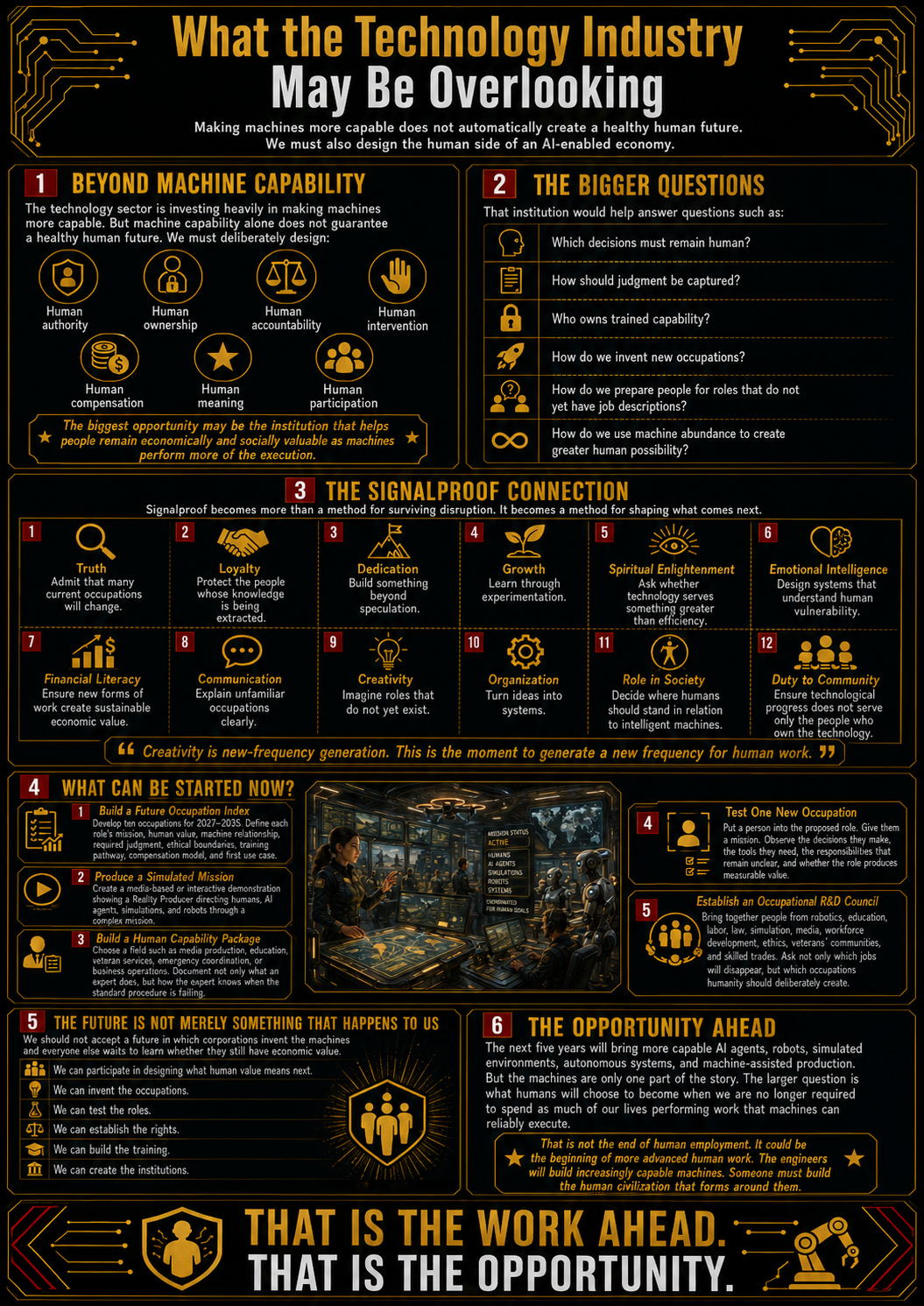
What the Technology Industry
May Be Overlooking
The technology sector is investing heavily in making machines more capable. But machine capability does not automatically create a healthy human future.
We must also design:
human authority;
human ownership;
human accountability;
human intervention;
human compensation;
human meaning;
and human participation.
The biggest opportunity may not be another machine that completes a task faster.
It may be the institution that determines how people remain economically and socially valuable when machines can perform more of the execution.
That institution could help answer:
Which decisions must remain human?
How should judgment be captured?
Who owns trained capability?
How do we invent new occupations?
How do we prepare people for roles that do not yet have job descriptions?
How do we use machine abundance to create greater human possibility?
The Signalproof Connection
This is where Signalproof becomes more than a method for surviving technological disruption. It becomes a method for shaping what comes next.
Truth requires us to admit that many current occupations will change.
Loyalty requires us to protect the people whose knowledge is being extracted.
Dedication gives us the discipline to build something beyond speculation.
Growth allows us to learn through experimentation.
Spiritual Enlightenment asks whether our technology serves something greater than efficiency.
Emotional Intelligence helps us design systems that understand human vulnerability.
Financial Literacy ensures new forms of work create sustainable economic value.
Communication gives us the ability to explain unfamiliar occupations.
Creativity allows us to imagine roles that do not yet exist.
Organization turns those ideas into systems.
Role in Society asks where humans should stand in relation to intelligent machines.
Duty to Community ensures that technological progress does not serve only the people who own the technology.
Signalproof teaches us that creativity is not merely artistic expression. Creativity is new-frequency generation. This is the moment to generate a new frequency for human work.
What Can Be Started Now?
We do not need to wait for fully autonomous humanoid robots. The work can begin today.
1. Build a Future Occupation Index
Develop ten occupations for the period between 2027 and 2035.
For each occupation, define:
its mission;
human value;
machine relationship;
required judgment;
ethical boundaries;
training pathway;
compensation model;
and first use case.
2. Produce a Simulated Mission
Create a media-based or interactive demonstration showing a Reality Producer directing humans, AI agents, simulations, and robots through a complex mission.
The simulation becomes research, education, proof of concept, and intellectual property.
3. Build a Human Capability Package
Select an accessible field such as media production, education, veteran services, emergency coordination, or business operations. Document not only what an expert does, but how the expert knows when the standard procedure is failing.
4. Test One New Occupation
Put a person into the proposed role. Give them a mission. Observe what decisions they make, what tools they need, what responsibilities remain unclear, and whether the role produces measurable value.
5. Establish an Occupational R&D Council
Bring together people from robotics, education, labor, law, simulation, media, workforce development, ethics, veterans’ communities, and skilled trades. Do not ask them only which jobs will disappear.
Ask: What occupations should humanity deliberately create?
The Future Is Not Merely Something That Happens to Us
We should not accept a future in which corporations invent the machines and everyone else waits to learn whether they still have economic value.
We can participate in designing what human value means next.
We can invent the occupations.
We can test the roles.
We can establish the rights.
We can build the training.
We can create the institutions.
The next great employment category may not have a name yet. That does not mean it is unrealistic. Every established occupation began as a response to a world that had changed.
The next five years will bring more capable AI agents, robots, simulated environments, autonomous systems, and machine-assisted production.
But the machines are only one part of the story. The larger question is what humans will choose to become when we are no longer required to spend as much of our lives performing work that machines can reliably execute.
That is not the end of human employment. It could be the beginning of more advanced human work. The engineers will build increasingly capable machines. Someone must build the human civilization that forms around them.
That is the work ahead. That is the opportunity. And that is where we must Get Signalproof.
Get your copy on Amazon Kindle.
https://signalproof.com/buybook
Blog Edited Using AI and Infographics and Images created Using AI