The Trust Tax
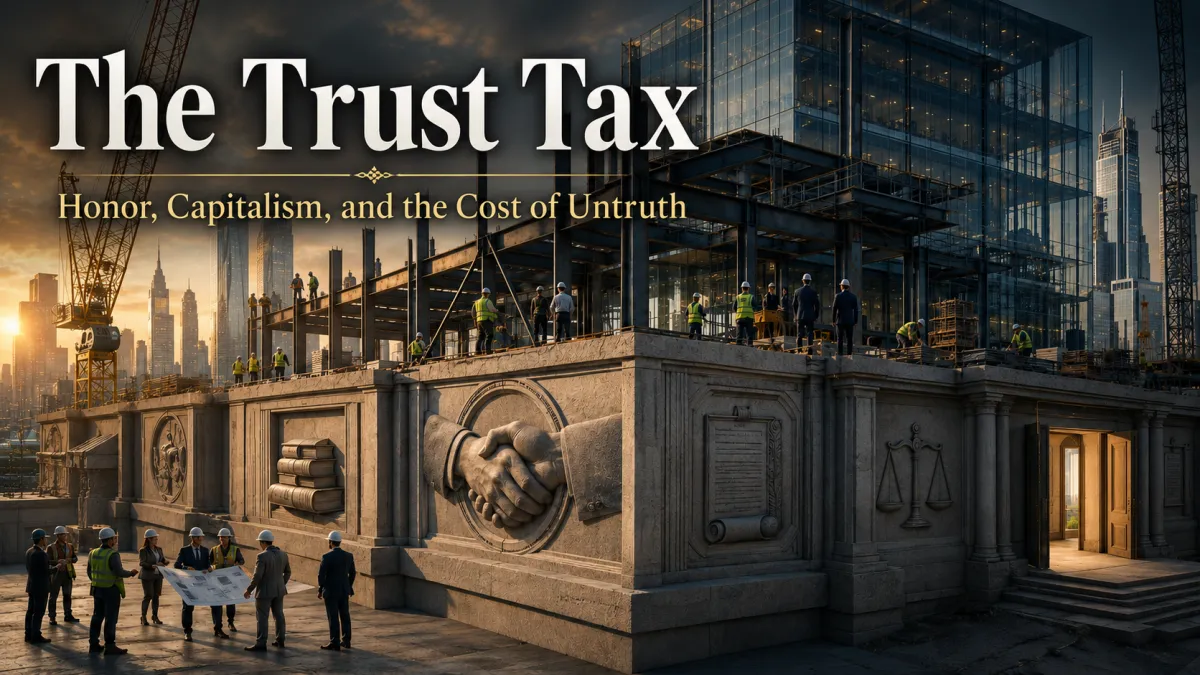
The Trust Tax: Honor, Capitalism, and the Cost of Untruth

What is the The Trust Tax and Why does it Matter?
There is a mentality growing in plain sight, though it is probably not new. It is the belief that if a person can frame the situation well enough, delay accountability long enough, or hide behind technical language skillfully enough, then they are right.
That is not honor. That is survival logic pretending to be morality.
The issue is not that people make mistakes. Everyone makes mistakes. The issue is when people, companies, and institutions use confusion as a tool. They say one thing publicly while doing another privately. They use contracts, policies, legal gray areas, branding, and carefully shaped narratives to create distance between what happened and who should be responsible for it.

This creates what I call the Trust Tax.
The Trust Tax is the extra cost honest people pay because dishonest people make trust dangerous. It is the cost of extra paperwork, extra proof, extra screenshots, extra lawyers, extra hesitation, extra suspicion, and extra emotional labor. It is the cost of entering every conversation wondering whether the other person is being clear or merely being strategic.
Capitalism cannot survive honorably under that mentality. Business depends on trust. A market is not only money moving between people. It is formed from the promises moving between people. A customer trusts that the product is what the seller claims. A client trusts that the service will be delivered. A partner trusts that the terms mean what they appear to mean. An employee trusts that effort will not be exploited. A company trusts that the person across the table is not using deception as leverage.
When that trust breaks, business does not become stronger. It becomes more defensive, more expensive, and more predatory.
Some people call this “just business.” But that phrase is often used to excuse behavior that would be recognized as dishonorable in any other setting. If someone benefits from confusion, hides behind technicalities, delays the truth, shifts responsibility, or wastes another person’s time with untruths, that is not business excellence. That is extraction.

Another common tool in this mentality is whataboutism.
Whataboutism is when a person avoids accountability by pointing to someone else’s wrongdoing instead of answering for their own. It sounds like a defense, but it is often a distraction. Instead of saying, “Here is what happened, here is what I did, and here is what I am responsible for,” the person says, “But what about them?” or “They did something wrong too.”
That tactic works because no person, business, group, or opposing side is perfect. If the other side makes even one mistake, that mistake can be isolated, exaggerated, stripped of context, and used to muddy the entire issue. The original wrongdoing is no longer the focus. Now the conversation becomes a contest over who looks worse.
But someone else’s failure does not erase your responsibility.
A mistake by the opposing side may deserve its own examination, but it does not automatically excuse deception, delay, manipulation, or bad faith from the first party. Whataboutism turns accountability into a fog. It reframes blame, exhausts the audience, and makes people feel as if truth is impossible to determine. That confusion benefits the person trying to escape the original question.

The question should not only be, “Was it illegal?” The deeper questions are:
Did you tell the truth clearly?
Did you benefit from another person’s misunderstanding?
Did you create confusion or simply allow it because it helped you?
Did you honor the spirit of the agreement, or only protect yourself inside the wording?
Did you make the situation harder to understand once accountability appeared?
Did you waste someone’s time because you were afraid to be honest?

A society does not lose morality only when people break laws. It loses morality when people stop feeling shame for manipulating the spaces between laws.
Honor is not outdated. Honor is infrastructure. It is what allows people to build, trade, collaborate, invest, hire, buy, sell, teach, and create without treating every interaction like a battlefield. If we want better business, we need to stop rewarding the people who are best at framing dishonor as strategy. We need to make truth attractive again, not because it is soft, but because it is efficient, scalable, and strong.
A person who lies to win once teaches everyone around them to verify
forever. And that is the real cost.
Ready to Make Your Business Work For You?
Join us for a Clarity Session at AINoHype.com

Written by Doc Reo, edited using AI. Images generated by AI.